It is the third week of July. Your air conditioner quits again. The technician replaces the same part he replaced last summer. You pay the bill and hope it ends there. Then it happens again.
Many North Carolina homeowners know this cycle. Hot, humid summers keep cooling systems running for months. Mild winters mean heat pumps and furnaces cycle often. Pollen, storms, and power surges add more stress. A system that fails once may fail again if no one finds the real cause.
A repair fixes a broken part. It does not always fix the reason the part broke. A capacitor may fail because of a loose wire. A coil may freeze because of poor airflow. A compressor may burn out after a slow refrigerant leak. Treat only the symptom, and the problem returns.
This guide shows how to prevent recurring HVAC failures in seven steps. You will see why repeat breakdowns happen, which parts need protection, and what to ask your technician. It also covers when repeated repairs signal that it is time to replace the system.
Why HVAC Systems Fail Again and Again
Most repeat failures follow a pattern. One small problem puts stress on other parts. The stress builds until something breaks. Then the cycle starts over.
The Domino Effect Inside Your System
HVAC parts depend on each other. A dirty filter reduces airflow. Low airflow freezes the evaporator coil. Ice floods the drain pan. Water damages the area around the unit. A frozen coil can also send liquid refrigerant to the compressor, which can damage it.
One ignored issue can lead to several failures. That is why a single repair often is not enough.
Common Causes of HVAC System Breakdowns
- Restricted airflow from dirty filters, blocked vents, or duct problems
- Dirty evaporator and condenser coils
- Refrigerant leaks
- Loose or corroded electrical connections
- Worn capacitors, contactors, and relays
- Clogged condensate drain lines
- Thermostat faults or poor settings
- Poor installation or incorrect equipment size
- Age and normal wear
Repeat Failure Patterns
Use this table to link a repeated symptom to a likely root cause.
| Repeated problem | Common hidden cause | What to ask your technician |
|---|---|---|
| Capacitor fails every year | Loose wiring, voltage issues, or heat stress | Did you test voltage and tighten connections? |
| Coil freezes again and again | Low airflow or low refrigerant | Did you measure airflow and refrigerant charge? |
| Water leaks from the unit | Clogged drain line or cracked drain pan | Did you clear the full line and check the pan? |
| System shuts off on hot days | Dirty condenser coil or failing fan motor | Did you clean the coil and test the fan? |
| Refrigerant recharged each season | A leak that was never repaired | Did you find and fix the leak? |
| Short run cycles | Oversized unit, bad thermostat, or overheating | Did you check sizing, settings, and temperature rise? |
Why Climate and Installation Matter
Eastern North Carolina and the Triangle bring high humidity. Moisture strains coils, drains, and ducts. Heavy pollen loads clog filters faster. Thunderstorms can cause power surges that damage control boards.
Installation quality also matters. An oversized system cycles on and off too often. Undersized ducts restrict airflow. Poor refrigerant charge shortens equipment life. Some repeat failures start on the day of installation.
Step 1: Fix the Root Cause, Not Just the Symptom
This step matters most. Every other step depends on it. A repair that ignores the cause is a temporary fix.
Keep a Repair Log
Write down every service call. Record the date, the symptom, the part replaced, and the cost. Keep invoices in one folder. Add the system’s model number and install date.
After two or three calls, patterns appear. You may see the same part failing each year. You may see problems every July or every January. These patterns help a technician see the real issue. Our overview of common air conditioner problems can help you spot repeat symptoms.
Ask Better Questions After a Repair
A good technician explains why a part failed. Ask these questions at the end of each visit:
- Why did this part fail?
- Could something else have caused it?
- What did you test besides the broken part?
- Is this likely to happen again?
- What should I watch for in the next few months?
Vague answers are a warning sign. Clear answers show the technician looked at the whole system.
Ask for Measurements
Good diagnosis uses numbers. A technician can measure voltage, amp draw, airflow, static pressure, refrigerant pressures, and temperature drop across the coil. These readings show how the system performs. They also catch weak parts before they fail.
A Real-World Example
A Fuquay-Varina homeowner replaced a capacitor two summers in a row. The third technician tested the system more fully. The condenser fan motor was drawing too many amps and overheating the capacitor. Replacing the motor ended the repeat failures. The earlier visits had fixed the symptom only.
Step 2: Protect Airflow and Filters
Restricted airflow causes more HVAC failures than almost anything else. Air carries heat away from the coil and the compressor. When airflow drops, parts run hot, ice forms, and motors work harder.
What Low Airflow Damages
- Evaporator coil: It can freeze when too little warm air passes over it
- Compressor: It can overheat or take in liquid refrigerant
- Blower motor: It strains against high resistance
- Heat exchanger: It can overheat in a furnace, which may trip a safety limit switch
- Heat pump: It loses efficiency and may run longer
Filters: Match and Replace
Check the filter each month during heavy use. Replace it when it looks gray and packed with dust. A 1-inch pleated filter usually lasts 60 to 90 days, and less in pollen season. Use the size your system calls for. Avoid a filter that is too dense for your blower, since it can restrict airflow on its own.
Check Returns, Vents, and Ducts
Keep supply and return vents open and clear. Make sure interior doors do not block return air. Ask a technician to check for leaky or crushed ducts if one room stays weak. Duct leaks waste conditioned air and add strain to the whole system.
Measure Static Pressure
Static pressure tells you how hard the blower works against the duct system. A reading well above the equipment rating means a hidden restriction. If your system has had repeat blower, coil, or compressor problems, ask for a static pressure test. It can point to a duct problem that parts replacement will never solve.
Step 3: Keep Evaporator and Condenser Coils Clean
Your system has two coils. Each one moves heat. When either coil gets dirty, the system works harder and fails sooner.
The Evaporator Coil
The evaporator coil sits indoors, above or inside the air handler or furnace. It absorbs heat from your air. Dust that passes the filter can form a film on the fins. Moisture makes it stick. The coil then loses capacity and may freeze.
Signs of a dirty or frozen evaporator coil include:
- Weak airflow that fades over a cycle
- Ice on the coil or refrigerant line
- Water around the indoor unit
- A system that runs long and cools poorly
If you see ice, shut the cooling off and set the fan to “on” to thaw it. Do not scrape the ice. A coil that freezes more than once needs a technician. The cause may be low airflow or low refrigerant.
The Condenser Coil
The condenser coil sits in the outdoor unit. It releases heat outside. Grass clippings, cottonwood fluff, pollen, leaves, and dirt clog the fins. A blocked condenser coil raises pressure inside the system. The compressor runs hotter. This is a common cause of compressor failure and summer shutdowns.
How to Protect the Outdoor Unit
- Keep at least two feet of clear space around the unit
- Trim shrubs and remove leaves and debris
- Aim lawn mower discharge away from the unit
- Rinse the outside of the coil gently with a garden hose when the system is off
- Do not use a pressure washer, since it bends the fins
- Do not cover the unit with a solid cover during use
Leave deep coil cleaning to a technician. Fins bend easily, and strong chemicals can damage the metal. A cleaning during an air conditioning service in Apex NC visit is a smart way to reduce the odds of repeat failures.
Step 4: Catch Refrigerant Leaks and Protect the Compressor
The compressor is the heart of the system. It is also the most expensive part to replace. Most compressor failures have a cause that came earlier. Refrigerant problems are one of the biggest.
Refrigerant Does Not Get Used Up
This point surprises many homeowners. Refrigerant circulates in a sealed loop. It does not burn off like fuel. If the level is low, there is a leak. Adding refrigerant without fixing the leak is a short-term patch. The system will run low again.
Why Low Refrigerant Hurts
- The coil can freeze, which cuts airflow
- The compressor runs hotter and works longer
- Cooling drops and energy bills rise
- Oil circulation may suffer, which can lead to wear
- Liquid refrigerant can reach the compressor and damage it
Signs of a Refrigerant Problem
- Warm air from vents in cooling mode
- Ice on the refrigerant line or coil
- Hissing or bubbling sounds
- Longer run times with poor cooling
- Higher electric bills for no clear reason
What to Ask For
If a technician adds refrigerant, ask where the leak is. A proper repair finds the leak with a leak detector or other approved method. Then the technician fixes it or explains the options. Refrigerant handling requires EPA certification. Never try to add refrigerant yourself.
Also note the refrigerant type. Older R-22 systems face high costs and limited supply, since R-22 production has been phased out. Newer systems use refrigerants such as R-410A or newer low-impact options. If an older system leaks again and again, replacement may be the more practical path.
Other Ways to Protect the Compressor
- Keep the condenser coil clean
- Keep airflow strong on the indoor side
- Fix electrical issues quickly, since weak capacitors and contactors stress the compressor
- Avoid short cycling, which means the system turns on and off too often
- Ask about a hard-start kit or surge protector if your technician recommends one
Step 5: Inspect Electrical Connections and Components
Electrical faults cause a large share of repeat HVAC repairs. Heat, vibration, and moisture wear down wiring and parts. Small problems often go unseen until a part fails.
Parts That Fail Most Often
- Capacitors: They give motors a start-up boost. Heat and age weaken them.
- Contactors: These switches start the outdoor unit. Contacts pit and burn over time.
- Relays and control boards: They manage system functions. Surges and moisture can damage them.
- Fan and blower motors: They draw more current as bearings wear.
- Wiring and terminals: They can loosen or corrode.
Why Electrical Parts Fail Repeatedly
A part may fail because something else is stressing it. Loose connections create heat. Heat damages the part. A weak capacitor makes a motor draw extra current. A worn motor then damages the next capacitor. Voltage swings from the utility or from storms also shorten parts life.
Systems in North Carolina face frequent summer thunderstorms. A surge can damage a control board in an instant. Lightning damage may not show up until weeks later.
What a Good Electrical Check Includes
Ask a technician to do these checks during a visit:
- Tighten all electrical connections
- Test capacitor values against their ratings
- Inspect the contactor for pitting or burn marks
- Measure amp draw on motors and compare to nameplate values
- Check supply voltage
- Look for signs of heat damage on wires and terminals
- Inspect the disconnect and breaker
Consider Surge Protection
A whole-home surge protector or an HVAC-specific surge device can reduce risk to control boards and motors. It does not stop a direct lightning strike. It does help against smaller surges. Ask a licensed electrician or HVAC technician what suits your system.
Safety Note
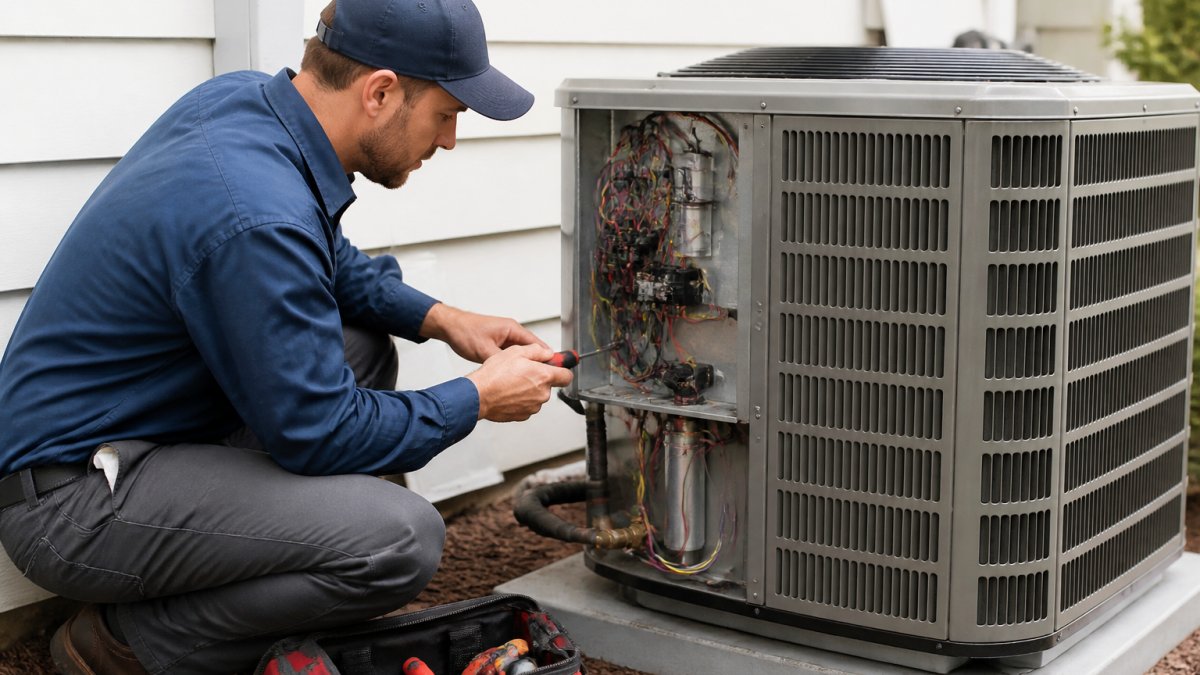
HVAC equipment carries high voltage. Capacitors can hold a charge even when the power is off. Do not open electrical panels or touch parts yourself. Call a licensed technician. If a furnace repeatedly fails to ignite or locks out, our furnace repair service in Cary NC can test the ignition system, sensors, and controls.
Step 6: Keep Condensate Drain Lines Clear
Your air conditioner removes a lot of water from the air. On a humid North Carolina day, a system can remove gallons of water. That water flows into a drain pan and out through a condensate line. If the line clogs, water backs up.
What Happens When a Drain Clogs
- Water overflows the pan and may damage ceilings, walls, or floors
- A safety float switch may shut the system off
- Standing water grows mold and algae
- Rust can form in the pan and cabinet
- Humidity rises in the home
A clogged drain is a classic repeat problem. Algae and slime grow back if no one treats the line. A one-time clearing may hold for a few months and then fail again.
Warning Signs
- Water around the indoor unit or under the air handler
- A musty smell near the unit
- The system shuts off with no clear cause
- A tripped float switch
- Stains on the ceiling below an attic unit
How to Keep the Line Clear
- Look for the drain line, a white PVC pipe near the indoor unit
- Pour a cup of distilled white vinegar into the access port each month in cooling season, as your technician advises
- Avoid bleach, which can harm some parts and does not always work well
- Check that the line slopes down and has no kinks
- Ask about a float switch or a drain pan sensor that shuts the system off before overflow
- Have the line flushed during a service visit
Attic Units Need Extra Care
Many Triangle homes have air handlers in the attic. A leak there can ruin a ceiling before you notice. A secondary drain pan and a float switch are a smart safeguard. Test the switch once a year. A small cost here can prevent major water damage.
Step 7: Monitor the Thermostat and Schedule Professional Inspections
The last step ties the rest together. You watch for early warning signs. You also bring in a professional to check what you cannot see.
Watch the Thermostat
The thermostat tells the system when to run. A faulty or poorly placed thermostat causes odd behavior and extra wear. Check for these issues:
- The display does not match the room temperature
- The system turns on and off in short cycles
- The system does not respond to setting changes
- The thermostat sits in direct sun, near a vent, or on a hot wall
- Batteries are weak or the screen is dim
Replace batteries each year. Keep the thermostat clean and away from heat sources. If you have a smart thermostat, check that its settings match your system type. A wrong setting can cause short cycling or heavy fan use. Large temperature setbacks can also make a heat pump run on backup heat. That raises costs and wear.
Learn Your System’s Normal Sounds and Smells
Pay attention to changes. You know your system better than anyone. These signs call for a service visit:
- New rattles, squeals, or grinding
- Burning or electrical smells
- Longer run times than before
- Higher bills with no change in use
- Rooms that feel less comfortable
- A system that struggles on the hottest or coldest days
Catching a change early often means a smaller repair. Waiting until the system stops usually costs more.
Schedule Professional Inspections With a Reliability Focus
A routine tune-up covers the basics. When you face repeat failures, ask for a deeper review. A reliability-focused inspection looks at the full system and the repair history. It may include:
- A review of past repairs and failed parts
- Measurement of voltage, amp draw, and capacitor values
- Airflow and static pressure testing
- Refrigerant pressure and temperature split checks
- Coil, drain line, and blower inspection
- A check of duct leakage and system sizing
- A written report with clear findings
The U.S. Department of Energy recommends regular professional maintenance to keep air conditioners efficient and to extend their life. A yearly HVAC maintenance tune-up in NC gives a technician the chance to catch weak parts before they leave you without cooling or heat.
When Repeat Failures Mean Replace, Not Repair
Sometimes prevention is not enough. Old equipment wears out. At some point, another repair is a poor use of money. Weigh the facts before you decide.
Signs Your System May Be Near the End
- It is 12 to 15 years old or older
- Repairs happen more than once a year
- A major part has failed, such as the compressor or heat exchanger
- It uses R-22 refrigerant and leaks
- Energy bills keep climbing
- Comfort has dropped in many rooms
A Simple Decision Guide
Use this table as a starting point. Your technician can give advice for your exact system.
| Situation | Usually better choice | Why |
|---|---|---|
| Newer system, minor repair | Repair | Low cost, long life remaining |
| Newer system, repeat failure with a clear root cause | Repair the cause | Fixes the pattern |
| Older system, one small repair | Repair, then watch closely | Low cost, but the age risk remains |
| Older system, major part failure | Compare repair and replacement | Repair cost may not match remaining life |
| Older system with repeated leaks or breakdowns | Replace | Repairs add up, and efficiency is low |
Some people use the 5,000 rule. Multiply the system’s age by the repair cost. If the number is above 5,000, replacement may be the better value. It is only a rule of thumb, so use it with care.
Our guide on the signs you need a new AC installation instead of repair explains how to weigh the decision.
Stop the Repair Cycle for Good
To prevent recurring HVAC failures, treat causes, not just symptoms. Track your repairs. Protect airflow. Keep both coils clean. Fix refrigerant leaks. Inspect electrical parts. Clear the drain line. Watch the thermostat and book a deeper inspection when problems repeat.
Here is a simple plan:
- Now: Start a repair log and check your filter
- This month: Clear space around the outdoor unit and test the drain line
- At your next visit: Ask why the part failed and request measurements
- This year: Schedule a reliability-focused inspection
You do not have to accept the same breakdown every summer. Better diagnosis and steady care can break the cycle.
Air Secure Inc is a local HVAC company serving Raleigh, Cary, Apex, Chapel Hill, and nearby North Carolina communities. Our technicians look past the broken part to find what caused it.
Contact Air Secure Inc to schedule an inspection and get a clear plan to stop repeat repairs.