Table of Contents
- What You’ll Need Before You Start Fixing HVAC Airflow
- Step 1: Check for Weak Airflow From Vents
- Step 2: Spot Dirty HVAC Air Filter Symptoms
- Step 3: Inspect Blocked or Leaking Air Ducts
- Step 4: How to Improve Airflow in a Room
- Step 5: Balance Dampers and Registers for Even HVAC Airflow
- Common Mistakes to Avoid When Fixing HVAC Airflow Issues
- When to Call an HVAC Technician in Cary, NC
- Frequently Asked Questions
Last Updated: October 19, 2026
What You’ll Need Before You Start Fixing HVAC Airflow
Most HVAC airflow problems are simple clogs or closed vents, and you can often fix them yourself in an afternoon. Before you start, gather a few basics so you don’t make three trips to the garage.
Here’s what to have on hand:
- A fresh air filter that matches your unit’s size
- A flashlight or phone light
- A screwdriver for vent covers
- Foil tape for duct seams
- A notepad to track which rooms feel weak
The U.S. Department of Energy’s home cooling guidance notes that proper airflow is one of the cheapest ways to cut cooling costs. That’s the whole point here: small fixes, real comfort gains.
Step 1: Check for Weak Airflow From Vents
Start by confirming the problem. Weak airflow from vents means your system moves less air than it should, so some rooms stay warm while others freeze. Walk through each room and hold your hand near every supply vent.
Ask yourself:
- Does the air feel strong, weak, or barely there?
- Is one room always the problem, or several?
- Does the vent whistle or rattle?
Write down what you find. A single weak vent points to a damper or duct issue. Weak flow everywhere usually means a dirty filter or a struggling blower. That distinction saves you time.
Step 2: Spot Dirty HVAC Air Filter Symptoms
A clogged filter is the most common cause of poor airflow, and it’s the easiest fix. Dirty HVAC air filter symptoms include weak airflow, a system that runs longer than usual, dust building up on vents, and higher energy bills.
Here’s the quick test. Pull the filter and hold it up to a light. If you can’t see light through it, it’s clogged. Replace it with the correct size and note the date.
A common mistake is buying the thickest “high-efficiency” filter on the shelf. Those dense filters can choke a standard residential system. Match the filter to what your unit was built for.
Running a system with a clogged filter strains the blower motor and can lead to a breakdown. If your filter looks gray and matted, replace it before you run the system again.
Step 3: Inspect Blocked or Leaking Air Ducts
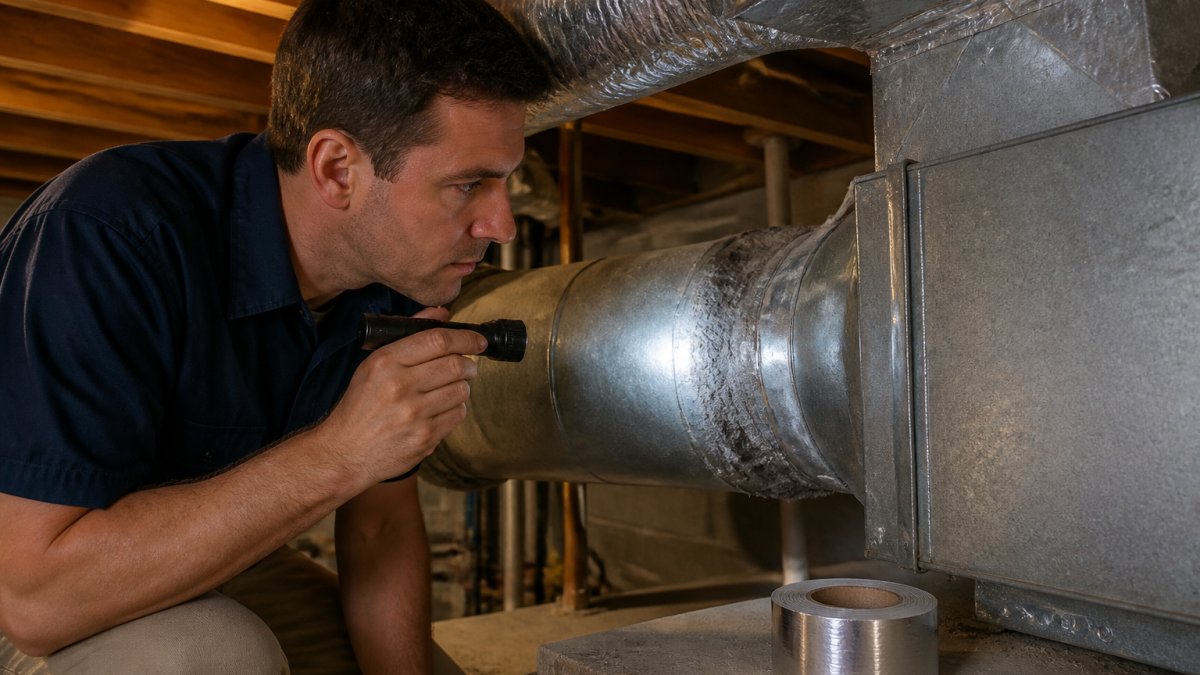
Blocked or leaking air ducts waste the cool air your system just paid to make. Check the accessible ducts in your basement, attic, or crawlspace. Look for crushed sections, disconnected joints, and gaps at the seams.
What to check:
- Ducts crushed behind furniture or under flooring
- Loose joints where sections meet
- Torn insulation or visible gaps
- Furniture or rugs covering return vents
Seal small gaps with foil tape, not duct tape. Duct tape dries out and fails. If you find a crushed or disconnected run, that’s often a job for a pro. The U.S. Environmental Protection Agency’s guide to duct sealing explains why sealed ducts matter for both comfort and air quality.
Step 4: How to Improve Airflow in a Room
Knowing how to improve airflow in a room often comes down to removing what’s blocking it. Start with the simple stuff before you assume the system is failing.
Try these fixes:
- Open the supply and return vents fully
- Move furniture off the vents
- Keep interior doors open, or add a return path
- Clear clutter around the outdoor unit
- Check that rugs aren’t covering floor registers
If one room stays weak after all that, the branch duct serving it may be undersized or dampered down. Note it and move to the next step.
A quick trick: crack the door to a stuffy room by an inch. If airflow improves, the room lacks a return path, not supply air. That’s a design issue, not a filter problem.
Step 5: Balance Dampers and Registers for Even HVAC Airflow
Balancing dampers and registers evens out the temperature across your home. Dampers are small levers inside your ductwork that control how much air reaches each zone.
Here’s how to balance them:
- Locate the damper handles near the main trunk
- Note which rooms run too hot or too cold
- Open dampers to cold rooms, close them slightly to hot ones
- Adjust in small steps, then wait a day
Don’t close dampers all the way. That raises pressure and can damage the blower. Small tweaks, tested over a day, work best.
| Problem | Likely Cause | Fix |
|---|---|---|
| One weak vent | Closed damper or crushed duct | Open damper, inspect duct |
| Weak airflow everywhere | Clogged filter or blower issue | Replace filter, call a pro |
| Hot and cold rooms | Poor balancing | Adjust dampers gradually |
| Dusty vents | Leaky ducts or old filter | Seal seams, replace filter |
Common Mistakes to Avoid When Fixing HVAC Airflow Issues
The biggest mistake is guessing instead of checking. Most people replace parts before they’ve confirmed the actual cause. That wastes money and rarely fixes the problem.
Watch for these:
- Using dense filters that choke airflow
- Sealing ducts with duct tape that fails
- Closing too many vents to “save energy”
- Ignoring a whistling vent that signals a blockage
- Skipping the filter change date
If you’ve replaced the filter, checked the vents, and balanced the dampers and the problem persists, the cause is likely inside the system. That’s when a pro saves you time.
When to Call an HVAC Technician in Cary, NC
Call a technician when DIY fixes don’t restore airflow, when you hear grinding or banging, or when one area stays stubbornly warm. Those point to blower, duct design, or refrigerant problems that need proper tools.
Air Secure Co has served Wake County since 2004 as a BBB A+ Accredited, licensed and insured team. We handle fast repairs, duct inspection, and 24-hour emergency heating service. If you’re searching for HVAC help near me in Cary, we’re built for exactly that call.
Frequently Asked Questions
Why is my HVAC system not blowing enough air?
The most common causes are a clogged air filter, closed or blocked vents, and duct leaks. Start by checking the filter and replacing it if it looks gray or matted. Then walk through each room and confirm every supply register is open and unobstructed. If airflow is still weak, inspect accessible duct runs for disconnected joints or crushed sections. A technician can measure static pressure to pinpoint hidden restrictions.
Can a dirty air filter cause HVAC airflow problems?
Yes. A dirty filter restricts return air, which starves the blower and lowers airflow at every vent. Common dirty HVAC air filter symptoms include weak airflow from vents, longer run times, higher energy bills, and dust settling on furniture. Check the filter monthly during heavy use and replace it every 1 to 3 months, or more often if you have pets or allergies, to keep HVAC airflow strong.
How can I tell if my HVAC ductwork is blocked or leaking?
Look for rooms that never reach the thermostat setting, whistling or rattling sounds at registers, and dust streaks near duct joints. In accessible spaces, check for disconnected flex duct, crushed sections, or tape peeling away. A simple test is to hold a tissue near a register; if it barely moves, the run may be blocked. For hidden ducts, a technician can perform a pressure test or use a camera.
When should I call an HVAC technician for airflow problems in Cary, NC?
Call a technician if you have replaced the filter, opened all registers, and airflow is still weak, or if you notice uneven temperatures across rooms. Also call if you hear banging or whistling from the ductwork, smell musty air, or see ice on refrigerant lines. In Wake County, a licensed HVAC contractor can measure static pressure, inspect ducts, and correct the underlying HVAC airflow issue safely.
Airflow problems rarely fix themselves, and a struggling system only works harder the longer you wait. If you’ve tried the steps above and your home still won’t cool evenly, let Air Secure Co take a look. Our licensed team offers fast repairs, duct inspection, and 24-hour emergency service across Wake County. Get a quote today and breathe easier.